


Ask ten people what the “core” is, and you’ll get ten different answers. For some, it’s the abs. For others, it includes the hips, back, or even the shoulders. The confusion makes sense when you think about how often the term gets tossed around in fitness, often without context or consistency. What’s not confusing is that a strong core only has upsides.
This blog breaks down what the core actually is, why it matters, and how to strengthen it safely. We’ll also look at how physical therapy can help build a foundation of strength and stability for everything you do, from lifting weights to playing with your kids.
What is the Core?
For this discussion, we’ll define the core as the muscles that directly move or stabilize the spine—those responsible for flexion, extension, side bending, and rotation. That includes the rectus abdominis, obliques, transverse abdominis, erector spinae, and quadratus lumborum. Other muscles, like the lats or glutes, can assist in stabilizing or transferring force through the trunk, but we’ll focus mainly on the spinal movers and stabilizers.
The core does two different jobs: resist movement & transmit force through movement. These muscles have to work in unison to both stabilize the trunk and allow efficient force active range of motion. When you tense your midsection to carry a heavy bag of groceries, you’re using your core to maintain stiffness and stability. When you swing a baseball bat, your core helps generate and transfer rotational power from your legs through your torso and into your arms. Whether the task is static or dynamic, your core is what connects everything together.
Key Benefits of a Strong Core
A strong, coordinated core benefits nearly every movement you perform. Here are some of the key advantages:
- Increased functional strength – A strong core enhances your ability to perform everyday activities that require lifting, bending, or twisting.
- Better balance & stability – Core muscles play a major role in balance by keeping your center of mass controlled over your base of support.
- Enhanced athletic performance – Nearly every sport relies on the core for force generation and transfer. From sprinting to throwing, your trunk is the bridge that connects lower-body power to upper-body output.
- Injury resilience & pain reduction
While a weak core isn’t always linked to back pain, poor trunk control can contribute to movement compensations and downstream issues.
Exercises to Strengthen Your Core
Core training can be divided into two general types of exercise. Isotonic exercises involve moving through a range of motion, while isometric exercises involve resisting movement to create stability. Both are valuable, and the examples below target different motions of the spine.
Squat
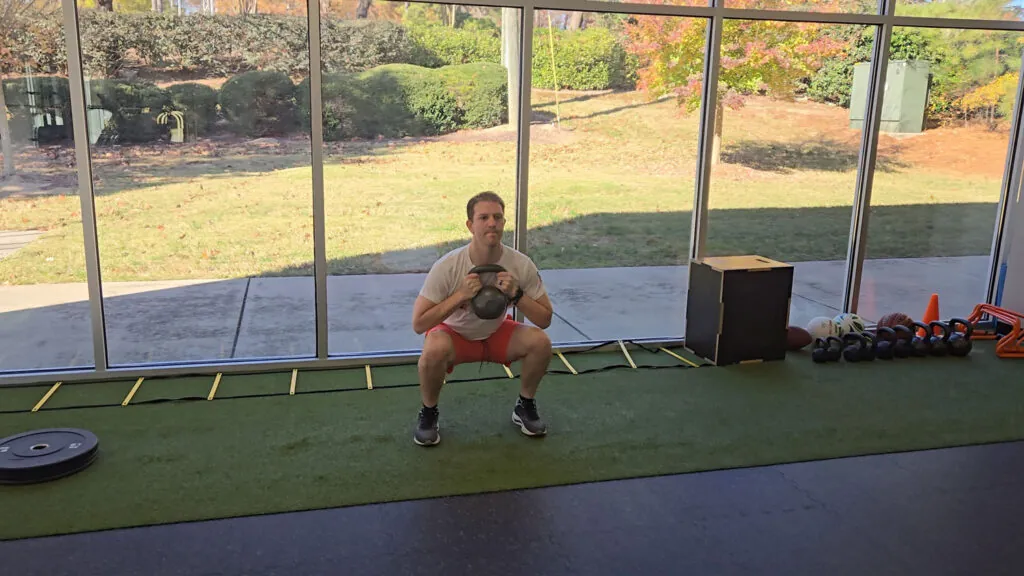
Benefit: Trains core stability through loaded hip and knee motion, challenging the trunk to maintain an upright posture.
How to do it: Stand with feet shoulder-width apart, brace your core, and lower your hips until your thighs are parallel to the floor. Keep your chest tall and spine neutral, then return to standing.
Plank with kettlebell pull-throughs
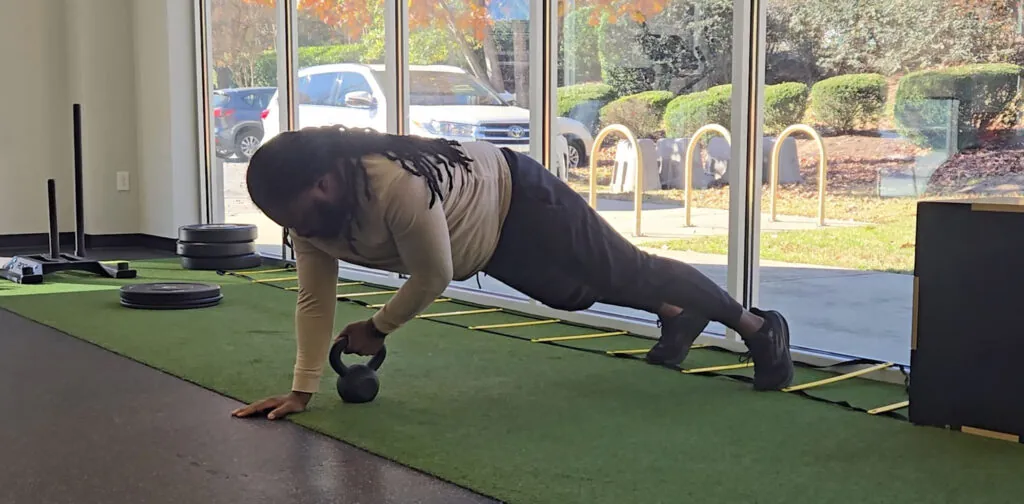
Benefit: Builds anti-extension and rotational stability by forcing the trunk to resist twisting and sagging.
How to do it: Start in a forearm plank with a kettlebell placed beside one arm. With minimal hip rotation, reach under your torso to drag the kettlebell to the opposite side. Alternate sides for controlled reps.
Kneeling single-arm landmine press
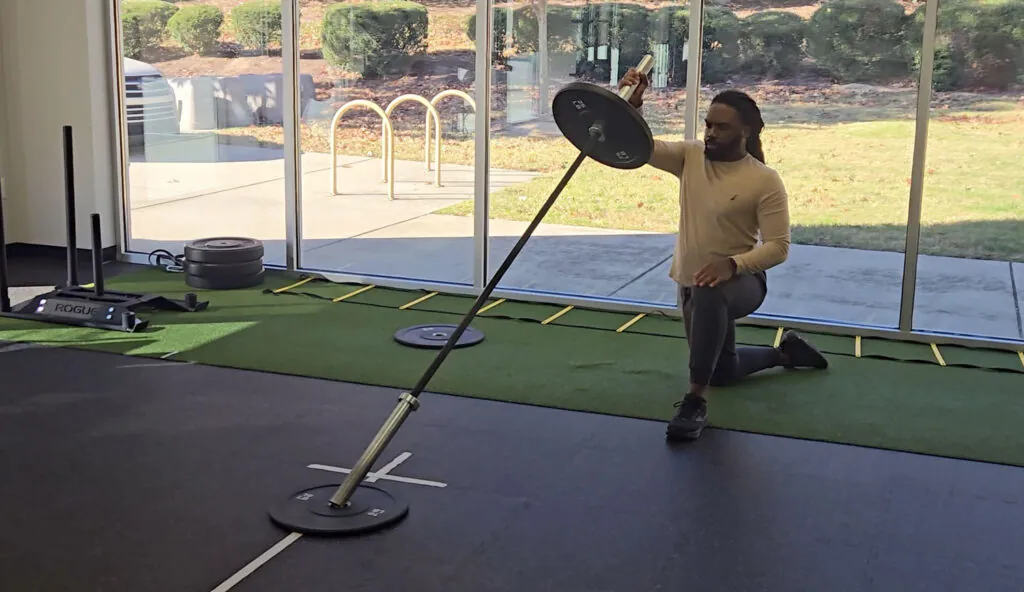
Benefit: Trains anti–side bending and challenges shoulder and trunk control.
How to do it: Kneel on one knee with the opposite arm pressing the landmine upward and slightly forward. Keep your torso tall and avoid leaning as you press.
Standing landmine rotations
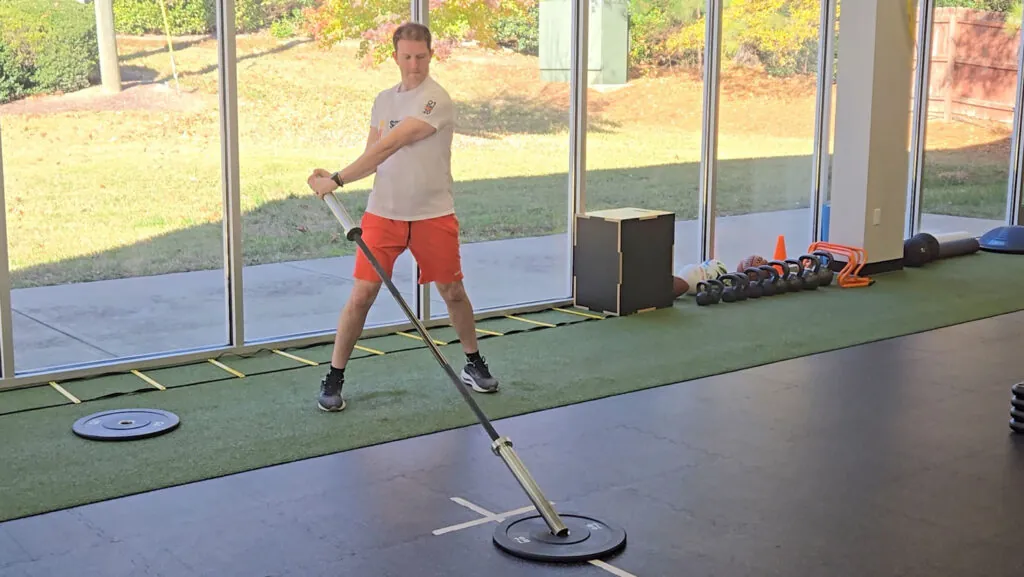
Benefit: Develops active rotational strength and control. Can be performed with or without hip rotation depending on the goal.
How to do it: Stand with feet slightly wider than shoulder-width. Holding the landmine with both hands, rotate the bar side to side in a controlled arc, pivoting your feet if desired. Focus on generating movement from your trunk rather than your arms.
How Physical Therapy Can Help
Physical therapy takes the guesswork out of core training. A PT can assess your movement patterns, strength, and pain triggers to identify what’s limiting you, then design a personalized program that challenges you safely. Each week, your plan can progress in load, reps, or complexity as your control improves. And on days when pain or fatigue are higher, your PT can modify exercises to keep you moving without aggravating symptoms.
Conclusion
The “core” may not have a single, universal definition, but it is a foundational component to your musculoskeletal health. A strong core supports everything from daily movement to athletic performance and plays a key role in reducing injury risk.
Whether you’re looking to improve strength or mobility, prevent injuries, or enhance athletic performance, physical therapy can help you build core strength safely and effectively. Use our interactive map tool to find a physical therapy clinic near you and start feeling better today.